
The Import options tab controls how Video Hub behaves during bulk imports and automatic imports of larger feeds. Find it under Videos → Settings, on the Import options tab.
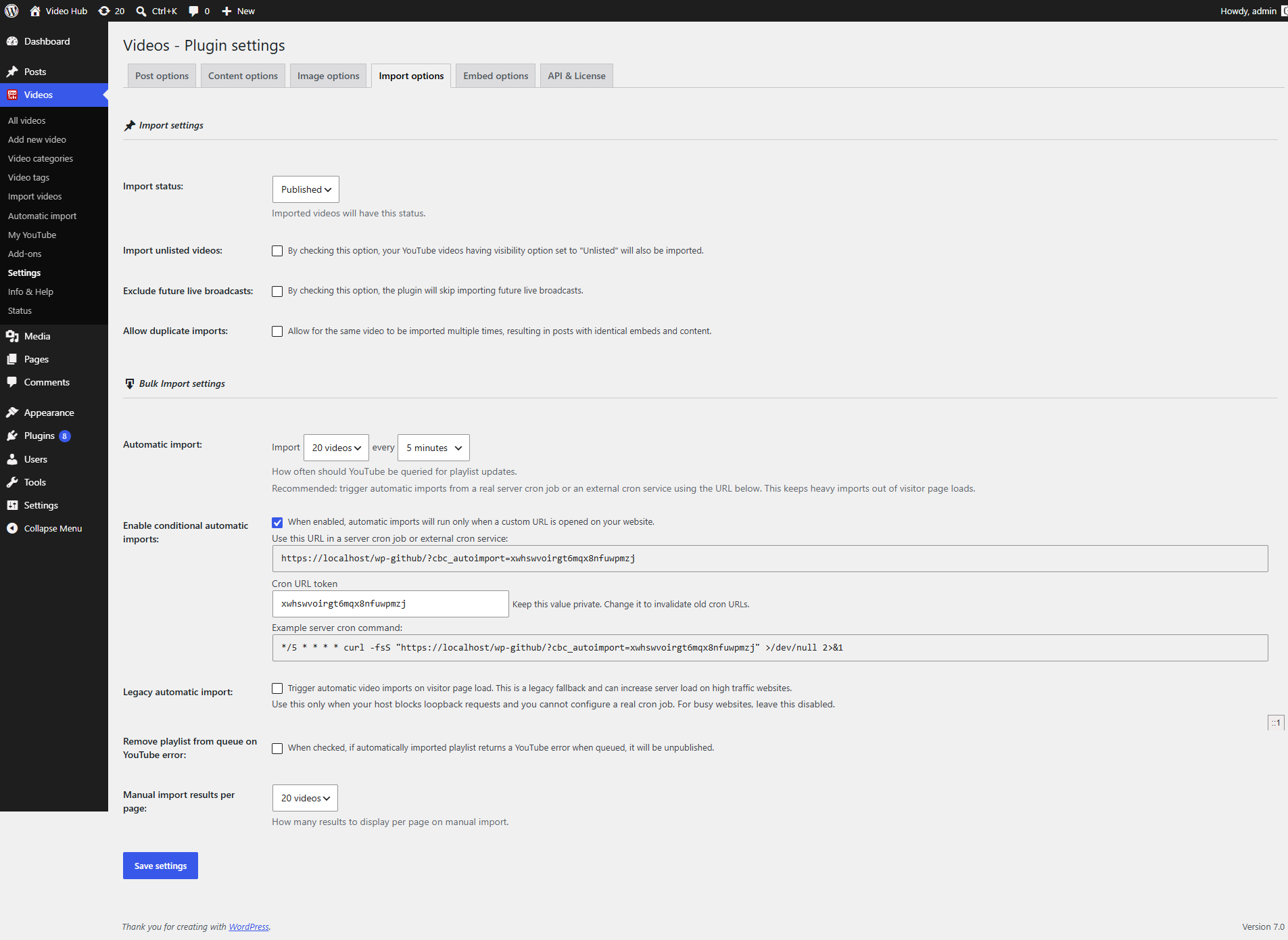
Import status
Set the default status for posts created from imported videos. Want to review them first? Choose Draft or Pending. Want them live right away? Choose Published.
Import unlisted videos
By default, Video Hub imports only public videos. Enable this to also import videos set to unlisted on YouTube.
Exclude future live broadcasts
When enabled, scheduled and upcoming live broadcasts are skipped, so only videos that are already available get imported.
Allow duplicate imports
By default, a video that’s already been imported is skipped. Enable this to allow the same video to be imported again, creating a separate post with identical embed and content.
Automatic import
Set how often automatic imports run and how many videos each run pulls. The maximum is 50, but don’t set it that high unless you’re confident your server can handle it.
Here’s why: importing 50 videos means creating 50 posts at once — and, if featured-image importing is on, 50 media-library entries at the same time. That’s a heavy process that can error out, so it’s best to keep it to 20 or fewer per run unless your server is comfortable with more.
Enable conditional automatic imports
With this on, an automatic import runs only when a specific URL is visited — even if the scheduled time has passed, nothing imports until that URL is hit. Video Hub shows the URL (unique to your site) when you enable the option, and it includes a secret token, so requests without the correct token are ignored.
It’s useful when your site doesn’t get enough traffic to trigger imports reliably, or when high traffic risks firing several imports at once. Point a server cron job at the URL on a schedule, or use any uptime/monitoring service to ping it at a set interval.
Legacy automatic import
Since version 1.2, automatic imports are triggered by a remote call to your site, which keeps page loads fast and makes the import smoother. This works on most setups, but if some hosting blocks it and your automatic imports stop running, enable this option to fall back to the older method.
Remove playlist from queue on YouTube error
An automatic import essentially tells Video Hub: import the YouTube playlist with ID X. If that playlist is later removed from YouTube, this option stops the plugin from repeatedly querying a playlist that no longer exists — the first time YouTube returns an error, imports for that playlist are paused, which also flags that something needs looking into.
Manual import results per page
Set how many videos appear per page when you run a manual bulk import.