
Automatic imports bring the videos of a YouTube channel, a playlist or a user’s uploads into your website, and keep importing the new ones as they are published. Each automatic import, also called an importer, runs in the background on a schedule: once it is in the import queue, you don’t have to do anything else.
To learn how the schedule works and how long a large feed takes, read The automatic import explained.
Before you start
- Set the import pace. In Videos → Settings, tab Import options, choose how many videos an import run reads and how often it runs. See Video import options.
- Importers take turns. Every run imports from a single importer, so the more importers are in the queue, the longer each one waits for its turn.
- Imports need WP-Cron. The imports run through WP-Cron and Action Scheduler, when your site has visitors. On a site with little traffic, or when the host disables WP-Cron, set up a server cron job. See Troubleshooting automatic imports.
Creating an automatic import
Go to Videos → Automatic import and click Add new. You can also create an importer from the Import videos page: load a channel or a playlist there and use Create automatic import, which fills the form for you.
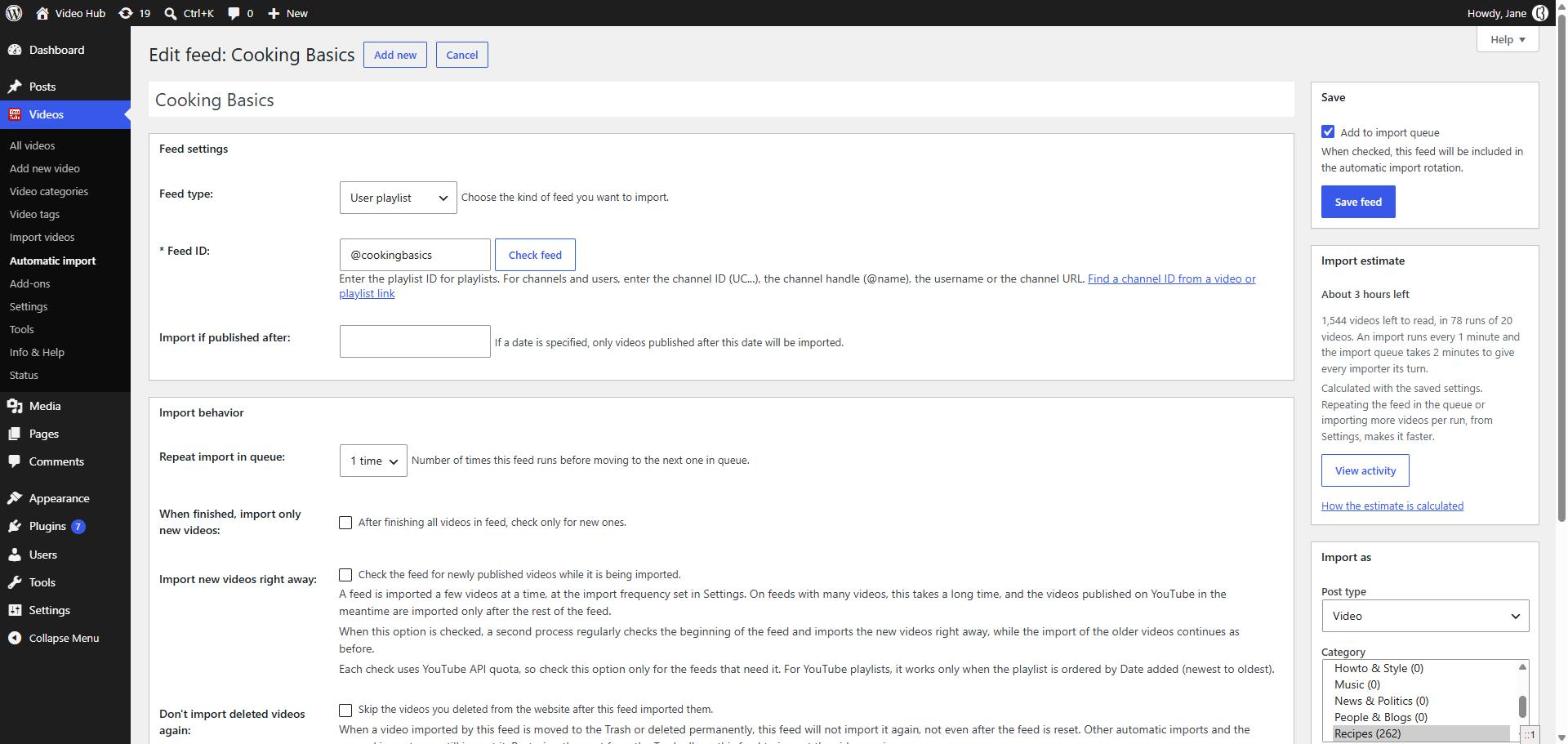
Feed settings
Feed name
A name for your own reference, shown in the list of importers.
Feed type and Feed ID
Choose YouTube channel, YouTube playlist or User playlist (a user’s uploads), then enter its ID. For playlists, enter the playlist ID. For channels and users, you can enter the channel ID (UC...), the channel handle (@name), the username or the channel URL. Click Check feed to make sure the ID returns the videos you expect. To find the ID of a channel, see How to find your YouTube channel ID.
Import if published after
Imports only the videos published after this date. Leave it empty to import the whole feed. The date applies to channels and user uploads, not to playlists.
Import behavior
Repeat import in queue
How many runs in a row this importer gets before the next importer in the queue. A higher value imports this feed faster, while the other importers wait longer.
When finished, import only new videos
After the importer reads the whole feed once, the next runs check only the beginning of the feed for new videos. When it is not checked, the importer reads the whole feed again and imports the videos that are missing, for example the videos you deleted. For playlists, order the playlist on YouTube by Date added (newest to oldest).
Import new videos right away
A large feed is imported over many runs. Without this option, the videos published on YouTube in the meantime wait until the importer reaches the end of the feed. When it is checked, a second process regularly checks the beginning of the feed and imports the new videos right away, while the older videos keep being imported. Each check uses YouTube API quota, so use it only for the feeds that need it. For playlists, it works only when the playlist is ordered by Date added (newest to oldest).
Don’t import deleted videos again
When a video imported by this importer is moved to the Trash or deleted, the importer won’t import it again, not even after a reset. Other importers and the manual imports can still import it, and restoring the post from the Trash allows the importer to import it again. The deleted videos are always recorded, so checking the option later also skips the videos deleted before.
Skip YouTube Shorts
Vertical or square videos up to 3 minutes long are considered Shorts and are not imported.
Video duration
Imports only the videos within a duration, in minutes. Leave a field empty for no limit; for example, fill only From with 10 to import the videos longer than 10 minutes.
Import as
In the Import as box, choose the post type, the categories, the status of the imported posts and, in the Author box, the user the posts are attributed to. The post status uses the default from the plugin settings unless you choose another one for this importer.
Save
Check Add to import queue to start importing, then click Save feed. Once the importer was checked at least once, the Import estimate box shows how long it needs to import the rest of the feed and links to its activity.
Managing automatic imports
The Automatic import page lists your importers. For each one you see:
- Status: active, next in the queue, importing, paused, or stopped because of errors. When YouTube returns an error, the message is displayed under the importer name, with the time of the next try.
- Imported: how many videos of the feed are on the website, out of the videos in the feed, the videos you deleted from the website and the time estimate. Hover the estimate to see how it is calculated.
- Category and Last checked: where the videos are imported and when YouTube was last checked.
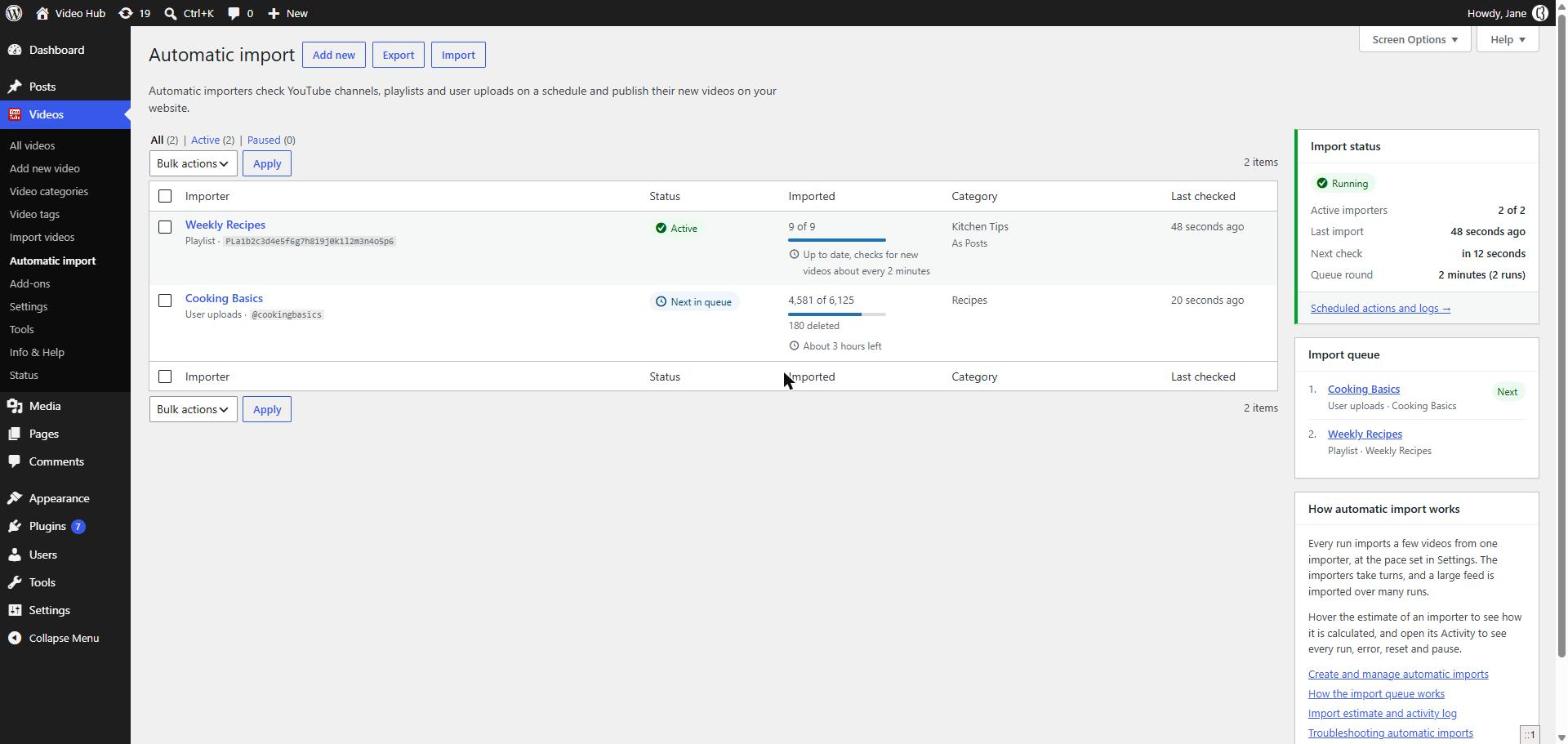
On the right, the Import status box shows whether the imports run, the last and the next import and how long the queue takes to give every importer its turn. The Import queue box shows the order of the next importers, and the How automatic import works box links to this documentation. The Help tab, at the top of the page, has a short explanation of each part.
Hover an importer to see its actions:
- Edit opens the importer settings.
- Activity shows everything the importer did: imports, checks that found nothing new, errors, resets, pauses and starts. See Import estimate and activity log.
- Pause takes the importer out of the queue and Start adds it back. The importer continues from where it stopped.
- Reset makes the importer read the feed again from its first video. The videos already imported are skipped, unless the plugin settings allow duplicates. The activity log and its totals are kept.
- Delete removes the importer. The videos it imported stay on your website.
Use Export and Import, next to the page title, to move your importers to another website.
See also
- The automatic import explained — how the import queue works.
- Import estimate and activity log — follow the progress of an importer.
- Troubleshooting automatic imports — when the videos don’t show up.
- Video import options — the import pace and the other import settings.